How does an industrial blower work ? A complete guide
Published on July 29, 2026
Product description
Industrial blowers are widely used in processes that require high air or gas flow rates at relatively low pressure. Among the most common technologies are rotary lobe blowers, also known as Roots-type blowers, which belong to the family of positive displacement blowers.
They are used in wastewater treatment, pneumatic conveying, food processing, plastics manufacturing, pulp and paper, cement production, and various chemical processes. Their role is to continuously move large volumes of air or gas and provide the stable, controlled pressure required by the industrial process.
Unlike high-pressure air compressors, industrial blowers are generally designed to deliver high flow rates at lower differential pressures. Depending on the technology and operating conditions, they can provide a robust and reliable solution for continuous-duty industrial applications.
At GEFI, we support industrial customers with the selection, sizing, and optimization of industrial blower systems tailored to their process requirements. Our solutions include PEDRO GIL RPG rotary lobe blower packages, designed for reliable operation in demanding industrial applications.
Table of contents
What is an industrial blower?
An industrial blower is a positive displacement machine designed to move large volumes of air or gas to slightly increase their pressure before injecting them into an industrial process.
The principle is based on positive displacement: air is drawn in, trapped in defined volumes, and then mechanically transferred to the discharge port. The pressure increase occurs primarily when this volume of air joins the supplied network.
This technology is particularly well-suited for applications requiring continuous flow, excellent availability, and limited maintenance.
Roots-type blowers are currently the gold standard for many industrial installations due to their mechanical simplicity and long service life.
Expert AdviceGEFI
When engineering an industrial blower system, airflow is often the primary sizing criterion, rather than maximum pressure.
An oversized blower can result in unnecessarily high power consumption and operating costs that exceed the actual process requirements.
A comprehensive process analysis helps identify the most suitable solution by considering airflow, pressure, system pressure drops and operating conditions.
What is an industrial blower?
An industrial blower is a machine designed to move large volumes of air or gas and generate the pressure required by an industrial process. Depending on the application, different blower technologies can be used, including positive displacement blowers, screw blowers, and turbo blowers.
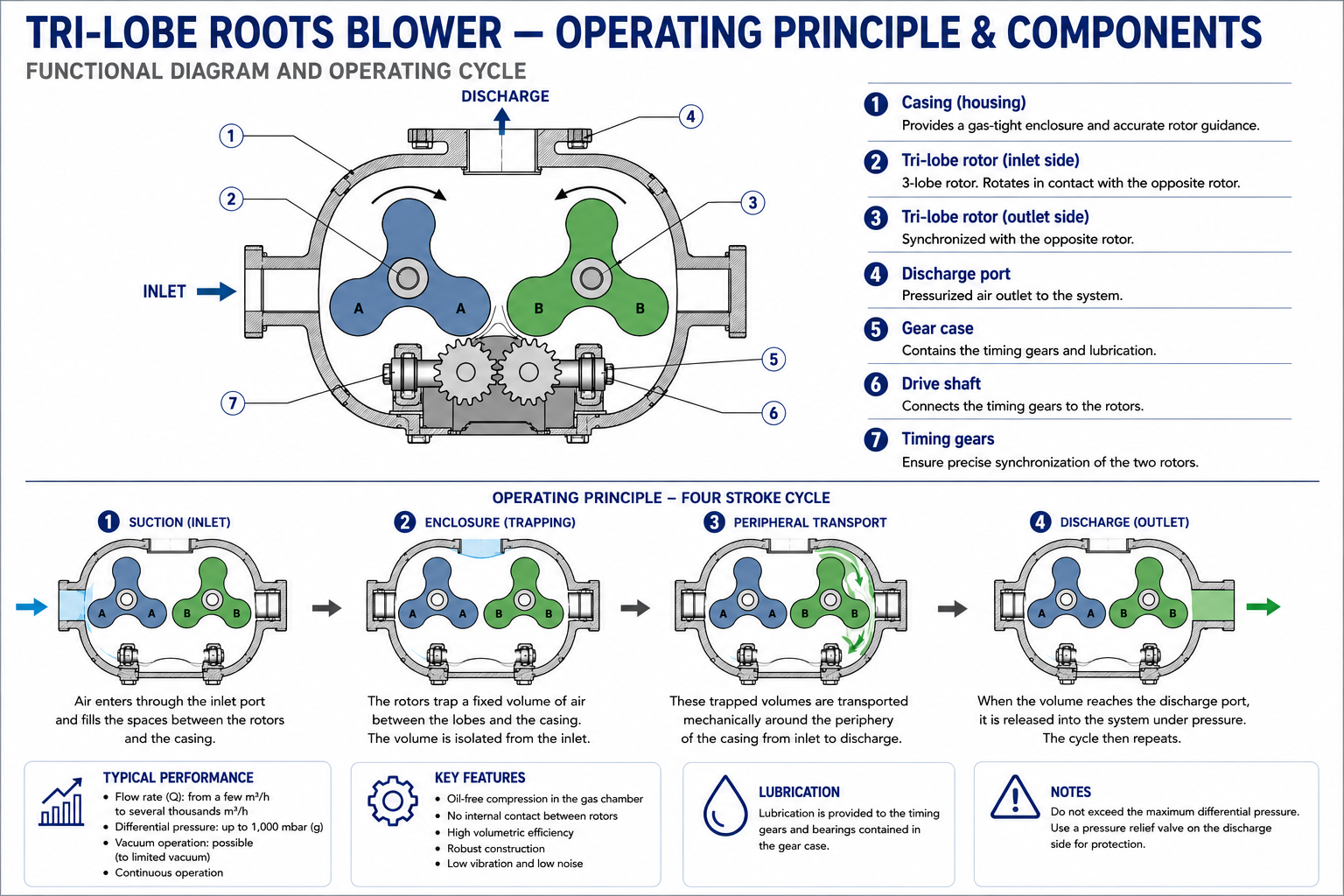
In the case of a rotary lobe blower, also known as a Roots-type blower, the operating principle is based on positive displacement. Air or gas is drawn into the blower, trapped between the rotating lobes and the casing, and mechanically transferred from the inlet to the discharge port. The pressure increases when the gas reaches the discharge side and encounters the resistance of the downstream system.
This technology is particularly well suited to industrial applications requiring continuous and stable flow, reliable operation, and relatively low maintenance requirements.
Thanks to their simple and robust design, Roots-type rotary lobe blowers are widely used in industrial applications requiring reliable air or gas delivery at relatively low pressure.
How does a blower work?
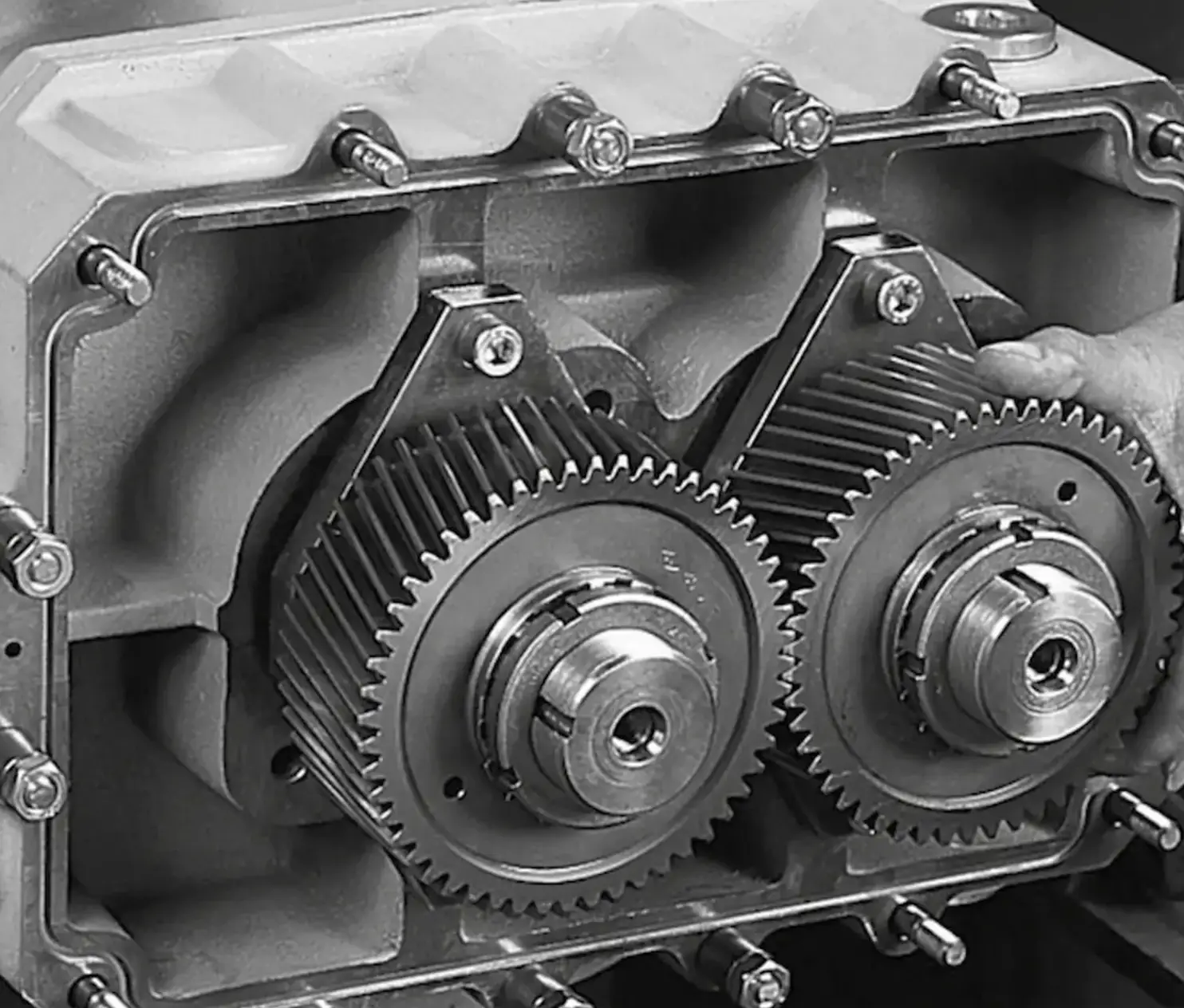
The operation of a blower, or rotary lobe blower, is based on two synchronized lobed rotors rotating in opposite directions inside a precision-machined casing. Modern industrial designs, such as three-lobe blowers, use specially shaped rotors to improve flow characteristics and reduce pressure pulsations.
Unlike a screw or piston compressor, a traditional Roots blower does not significantly compress the air internally within the pumping chamber.
Instead, the rotating lobes trap defined volumes of air or gas and mechanically transfer them from the inlet side to the discharge side.
Intake: Air or gas enters the blower through the inlet port and fills the spaces between the rotors and the blower casing.
Air volume entrapment: As the lobes rotate, a defined volume of air or gas becomes trapped between the rotor lobes and the casing.
Peripheral transport: The trapped volume is mechanically carried around the periphery of the blower casing toward the discharge side.
Discharge: When the trapped volume reaches the outlet, it encounters the backpressure of the downstream system and is discharged into the process. The cycle then repeats continuously. This simple mechanical operating principle, combined with non-contacting synchronized rotors, contributes to the robustness, reliability, and suitability of Roots blowers for continuous-duty industrial applications.
How is blower pressure measured?
To fully understand how an industrial blower works, it is important to distinguish positive pressure from the pressure conditions encountered in vacuum applications.
While a vacuum pump operates below atmospheric pressure, a blower typically operates above atmospheric pressure. Its purpose is to increase the pressure of air or gas sufficiently to overcome the resistance of the downstream process or system.
Blower pressure is commonly expressed as gauge pressure, using units such as mbar(g), bar(g), or kPa(g).
Flow rate is generally expressed in m³/h, Nm³/h, or m³/min, depending on the manufacturer, application, and reference conditions used.
Many industrial Roots-type rotary lobe blowers operate at differential pressures of up to approximately 1,000 mbar(g), or 1 bar(g), while delivering flow rates ranging from a few tens to several thousand cubic meters per hour. The exact operating range depends on the blower design, size, speed, and application.
It is important to remember that an industrial blower should never be selected based solely on its maximum pressure. The required flow rate, system pressure losses, operating point, gas characteristics, and process requirements are equally important when sizing a blower.
What is the difference between an industrial blower and an industrial compressor?
Although both industrial blowers and compressors are used to move and pressurize gas, they are designed for different pressure and flow requirements.
A blower is generally designed to deliver relatively high volumes of air or gas at low pressure. It is particularly well suited to continuous-duty applications such as aeration, pneumatic conveying, process air supply, and industrial blowing.
An industrial gas compressor, on the other hand, is designed to achieve significantly higher pressure ratios. It is commonly used to supply compressed-air networks, pneumatic tools, actuators, cylinders, and other equipment requiring several bars of operating pressure.
The main difference therefore lies in their typical pressure and flow characteristics: industrial blowers are optimized for high flow rates at relatively low pressure, while compressors are designed for applications requiring higher pressures.
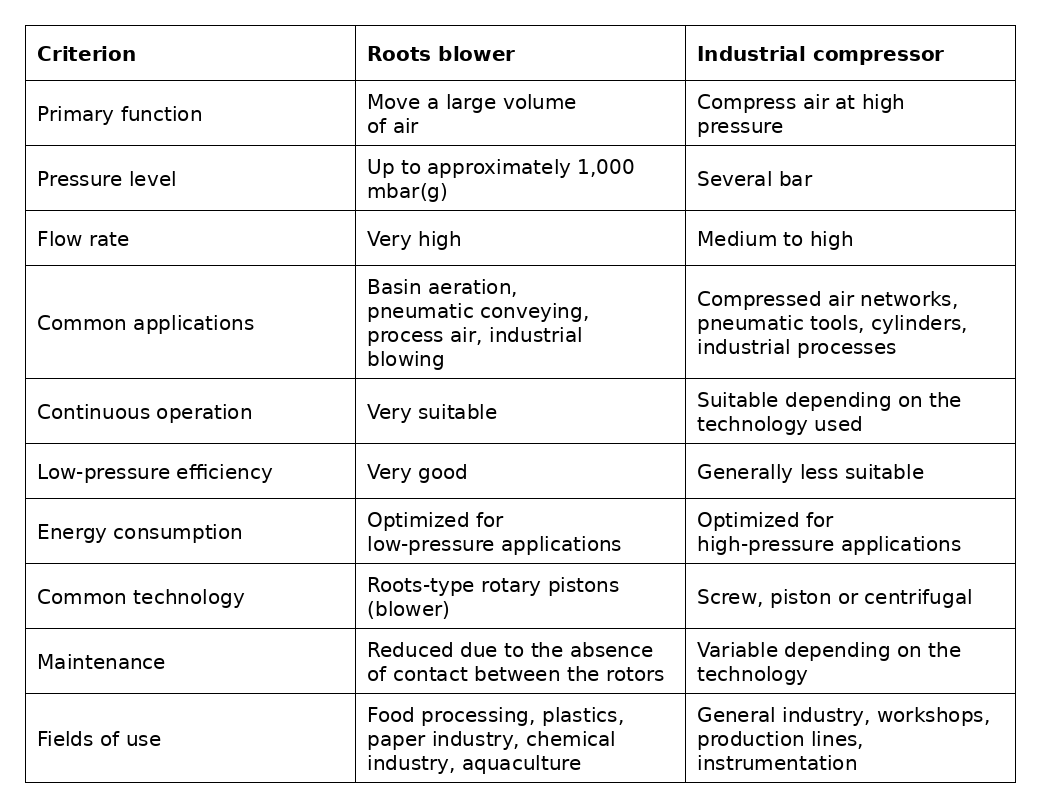
Comparison between a Roots blower and an industrial compressor:
The benefits of blower technology
Roots technology is one of the most widely used solutions for industrial blowing and low-pressure air applications.
Its simple operating principle, based on two synchronized, non-contacting rotors, provides excellent mechanical robustness and reliable performance in continuous-duty applications.
Roots-type rotary lobe blowers are particularly well suited to applications requiring high air or gas flow rates at relatively low differential pressures.
Compared with more complex blower technologies, they offer an attractive combination of reliability, ease of maintenance, investment cost, and operating performance, depending on the application and operating point.
Key advantages
Stable flow over a wide operating range.
Suitable for continuous 24/7 operation.
Non-contacting rotors, helping to limit wear within the compression chamber.
Straightforward preventive maintenance.
Long service life when properly operated and maintained.
Well suited to many low-pressure applications.
Robust design for demanding industrial environments.
Available in a wide range of sizes and configurations.
Suitable for aeration, pneumatic conveying, and process air applications.
The most widely used industrial blower technologies
Not all industrial applications require the same blower technology.
The choice depends primarily on the required airflow, differential pressure, energy efficiency targets, operating profile, maintenance requirements, and the characteristics of the industrial process.
The main technologies used in industry include:
Roots-type rotary lobe blowers.
Roots-type blowers are widely used for industrial air supply, wastewater aeration, pneumatic conveying, and process air applications.
They are characterized by high flow capacity, a simple and robust mechanical design, reliable operation, and suitability for continuous-duty applications.
Screw blowers use internal compression and can offer higher energy efficiency than traditional rotary lobe blowers within certain pressure and operating ranges. They can also provide smoother airflow with reduced pulsation.
Centrifugal and turbo blowers are particularly well suited to applications requiring very high airflow rates and can provide high energy efficiency when operating close to their design point.
Complete blower packages, ready for installation, combine the blower, motor, drive system, silencers, safety devices, and control instrumentation in a single manufacturer-engineered assembly.
Key industrial applications for blowers
Thanks to their ability to provide reliable, continuous low-pressure airflow, industrial blowers are used across a wide range of industries.
They provide the process air required for applications such as aeration, pneumatic conveying, and other continuous industrial processes. Correct blower selection and sizing are essential to achieve reliable operation while controlling energy consumption and maintenance requirements.
Wastewater treatment plants and biological basin aeration
Wastewater treatment plants use aeration blowers to supply air to biological treatment basins. The oxygen transferred into the wastewater supports the microorganisms responsible for breaking down organic matter. Reliable and continuous airflow is therefore essential to maintaining effective biological treatment.
Pneumatic conveying
Pneumatic conveying systems transport powders, granules, and other bulk materials through pipelines using a controlled airflow. Industrial blowers provide the flow and pressure required to move these materials through the conveying system.
This technology is widely used in plastics processing, cement production, the food industry, and mineral processing.
At GEFI, the sizing of pneumatic conveying blower systems takes into account the required flow rate, system pressure losses, available differential pressure, and process conditions to optimize the overall performance of the installation.
Unsure about sizing your blower?
Every process has its own unique constraints. GEFI helps you choose the right blower package, without unnecessary oversizing.
Choosing the right industrial blower package involves more than simply comparing a few technical specifications. Every process has its own operating requirements, and proper blower selection requires a comprehensive assessment of the installation and actual operating conditions.
The required airflow is a key sizing criterion
The required flow rate represents the volume of air or gas the blower must deliver to the process. It is one of the main criteria when sizing an industrial blower. Insufficient airflow can reduce process performance, disrupt production, or limit overall system capacity.
Operating pressure: matching the blower to process requirements
The required blower pressure must account for pressure losses throughout the system, including piping, filters, valves, silencers, and process equipment, as well as the pressure required at the point of use. Excessive oversizing can increase energy consumption and operating costs without providing a meaningful process benefit.
Duty cycle: matching the blower to actual operating conditions
Some installations operate only a few hours per day, while others run continuously, 24/7. The operating profile, load variations, and number of operating hours should therefore be considered when selecting the blower configuration, motor, cooling system, drive system, and control strategy.
In some industrial environments, noise is an important selection criterion. Blower packages equipped with appropriately designed silencers and acoustic enclosures can help reduce sound levels and improve working conditions without compromising the required process performance.
Energy efficiency: controlling operating costs
Energy consumption can represent a significant part of the total cost of ownership of an industrial blower. Correctly sizing the blower for the actual operating point and selecting a technology suited to the process can help avoid unnecessary energy consumption and reduce long-term operating costs.
Expert AdviceGEFI
The best blower is not necessarily the most powerful one.
The right solution is the one whose performance precisely matches the actual requirements of the industrial process, providing the optimal balance between flow rate, pressure, energy efficiency and operating costs.
GEFI offers PEDRO GIL RPG blower packages, available in a wide range of flow rate and power configurations.
These ready-to-install packages integrate the blower, drive motor, safety devices and all accessories required for fast commissioning on site.
Why optimize your blower system?
In many industrial facilities, blower systems operate for years without a detailed assessment of their actual performance.
However, an incorrectly sized, poorly adjusted, or aging blower system can increase energy consumption and operating costs while gradually reducing process efficiency and reliability.
The main causes of efficiency loss are:
Airflow that does not match actual process demand
Operating pressure set higher than necessary
Excessive pressure losses in the air network
Clogged or poorly maintained filters
Optimizing the installation can lead to:
Potential Optimization
Expected Benefit
Reduced power consumption
Lower energy costs
Improved flow stability
Greater process stability
Reduced production downtime
Increased system availability
Extended equipment service life
Reduced wear and fewer replacements
Reduced maintenance costs
Better overall maintenance control
At GEFI, we regularly carry out technical assessments to identify the most relevant opportunities for improving blower system performance before any investment is made.
PEDRO GIL RPG blower packages: a turnkey solution
PEDRO GIL RPG rotary lobe blower packages are designed for industrial users looking for a robust, reliable solution that can be easily integrated into their facilities.
Each package combines a three-lobe rotary blower with a matched electric motor, drive system, silencers, safety equipment, and the instrumentation required for reliable operation. Additional control, monitoring, and safety options can be selected according to the application and installation requirements.
The RPG range covers a wide variety of industrial requirements, with capacities of up to 10,500 m³/h and pressure levels of up to 1,000 mbar(g), depending on the model and operating conditions.
Acoustic enclosure configurations and noise-reduction solutions are also available to meet the acoustic requirements of industrial sites.
Available configurations:
Variant
Features
Standard DT
Complete package, ready for connection
K enclosed version
Enhanced noise reduction
50 Hz version
European standard
60 Hz version
Export applications
High-pressure version
Depending on model
High-flow version
DN150 to DN300
Compact version
DT4 to DT20
The most common mistakes when choosing an industrial blower
Selecting a blower based solely on pressure.
Underestimating system pressure losses.
Failing to consider continuous 24/7 operation.
Overlooking noise and acoustic requirements.
Unnecessarily oversizing the blower system.
Industrial blowers are essential in many applications requiring a continuous, reliable, and efficient supply of process air.
Whether for wastewater aeration, pneumatic conveying, material handling, or process air supply, selecting the right blower requires a detailed analysis of operating conditions, process requirements, and performance objectives.
With its expertise in industrial vacuum and low-pressure systems, GEFI supports industrial customers with the selection, sizing, integration, and maintenance of high-performance blower packages, including PEDRO GIL RPG rotary lobe blower solutions.
GEFI expertise for your industrial blower and pressure system project
At GEFI, our approach goes beyond simply supplying equipment. We analyze the complete industrial process to recommend a solution suited to the required airflow, pressure, energy efficiency, maintenance requirements, and operating conditions.
This process can reveal optimization opportunities that go well beyond simply replacing an existing machine.
Choosing an industrial blower involves more than selecting a machine from a catalog.
Every industrial process has its own requirements in terms of airflow, differential pressure, system pressure losses, operating environment, maintenance, and energy efficiency.
At GEFI, our approach is based first and foremost on understanding the process and the customer's actual operating requirements.
We support industrial customers with:
Technical assessment of existing installations
Sizing of industrial blower packages
Selection of the most suitable blower technology
Integration into new or existing air networks
Optimization of energy performance
Equipment maintenance and performance monitoring.
Our expertise covers solutions from established manufacturers in the industrial blower, compressed air, and vacuum sectors, including Pedro Gil, DVP Vacuum Technology, Pneumofore, and MD-Kinney.
This range of technologies enables us to recommend a solution that matches the specific requirements of each project without being limited to a single technology or product range.
Our goal is to provide a reliable, durable, and cost-efficient installation that is properly sized for actual process requirements and operating conditions.
Components to monitor:
During preventive maintenance, particular attention should be paid to the rotors, timing gears, bearings, shaft seals, drive belts, lubrication system, inlet filters, intake and discharge silencers, and safety devices. Regular inspection of these components helps maintain blower reliability, performance, and service life.
Need technical support ?
The GEFI team is at your disposal to study your project and offer a pressure solution perfectly suited to your industrial application. Contact us for a personalized study or to request a quote.
What is the difference between a blower and a compressor ?
An industrial air compressor is generally designed to achieve much higher pressures, while a blower is optimized to deliver high air or gas flow rates at relatively low pressure. This makes blowers particularly well suited to applications such as aeration, pneumatic conveying, and process air supply.
How does a Roots blower work ?
A Roots-type rotary lobe blower uses two synchronized rotors that rotate in opposite directions inside a precision-machined casing. The rotors trap defined volumes of air or gas and mechanically transfer them from the inlet to the discharge side without significant internal compression.
Can a blower run continuously ?
Yes. Many industrial blowers are designed for continuous-duty applications and can operate 24/7 when correctly selected, sized, installed, and maintained for the required operating conditions.
What maintenance is required ?
Regular preventive maintenance helps maintain blower reliability, performance, and service life. Depending on the blower design and installation, maintenance may include checking or replacing filters, lubricants, drive belts, bearings, seals, silencers, and safety components.
How do I choose the right flow rate ?
The required airflow must be determined according to the industrial process, actual demand, system pressure losses, required differential pressure, and operating conditions.
A technical sizing study or process assessment can help avoid both undersizing and unnecessary oversizing of the blower system.
Do blowers consume a lot of energy ?
Energy consumption depends on the blower technology, required flow rate and pressure, operating profile, control strategy, and overall system efficiency.
Correct blower sizing and optimization of the operating point can help reduce unnecessary energy consumption and control long-term operating costs.
An engineer who graduated from Université Paris XI-Saclay and holds a Master's degree in innovation and industrial marketing from Université Paris IX-Dauphine, Ronan Guyader has notably led international subsidiaries of the Air Liquide group.
Since 2021, he has headed GEFI, a solutions integrator specializing in vacuum, overpressure, gas compression and composite covers.