How does an industrial booster pump work? A complete guide
Published 07/29/2026
Description de l'article
Industrial blowers, also known as rotary lobe blowers or positive displacement blowers, have become essential equipment in many processes requiring high airflow at low pressure.
They are found in wastewater treatment plants, pneumatic conveying, the food industry, plastics processing, paper mills, cement plants, and various chemical processes. Their role is to move large volumes of air continuously to supply an industrial process requiring stable and controlled overpressure.
Unlike a high-pressure air compressor, a blower is designed to provide a high flow rate at relatively low pressure, while offering excellent mechanical reliability and reduced operating costs.
At GEFI, we assist industrial clients with the selection, sizing, and optimization of blowing solutions tailored to their processes. We notably offer Atlas Copco LUTOS DT blower packages, equipped with Roots blowers known for their robustness and continuous operation.
Table des matières
What is an industrial blower?
An industrial blower is a positive displacement machine designed to move large volumes of air or gas to slightly increase their pressure before injecting them into an industrial process.
The principle is based on positive displacement: air is drawn in, trapped in defined volumes, and then mechanically transferred to the discharge port. The pressure increase occurs primarily when this volume of air joins the supplied network.
This technology is particularly well-suited for applications requiring continuous flow, excellent availability, and limited maintenance.
Roots-type blowers are currently the gold standard for many industrial installations due to their mechanical simplicity and long service life.
ConseilGEFI
Lors de l'étude d'un projet d'installation de surpression industrielle, le débit est souvent le véritable critère dimensionnant, davantage que la pression maximale.
Un surpresseur surdimensionné peut entraîner une consommation électrique inutilement élevée et un coût d'exploitation supérieur aux besoins réels.
Une analyse complète du procédé permet d'identifier la solution la plus adaptée en tenant compte du débit, de la pression, des pertes de charge et du mode de fonctionnement.
The main components of an industrial blower
Most industrial blowers are based on a similar architecture.
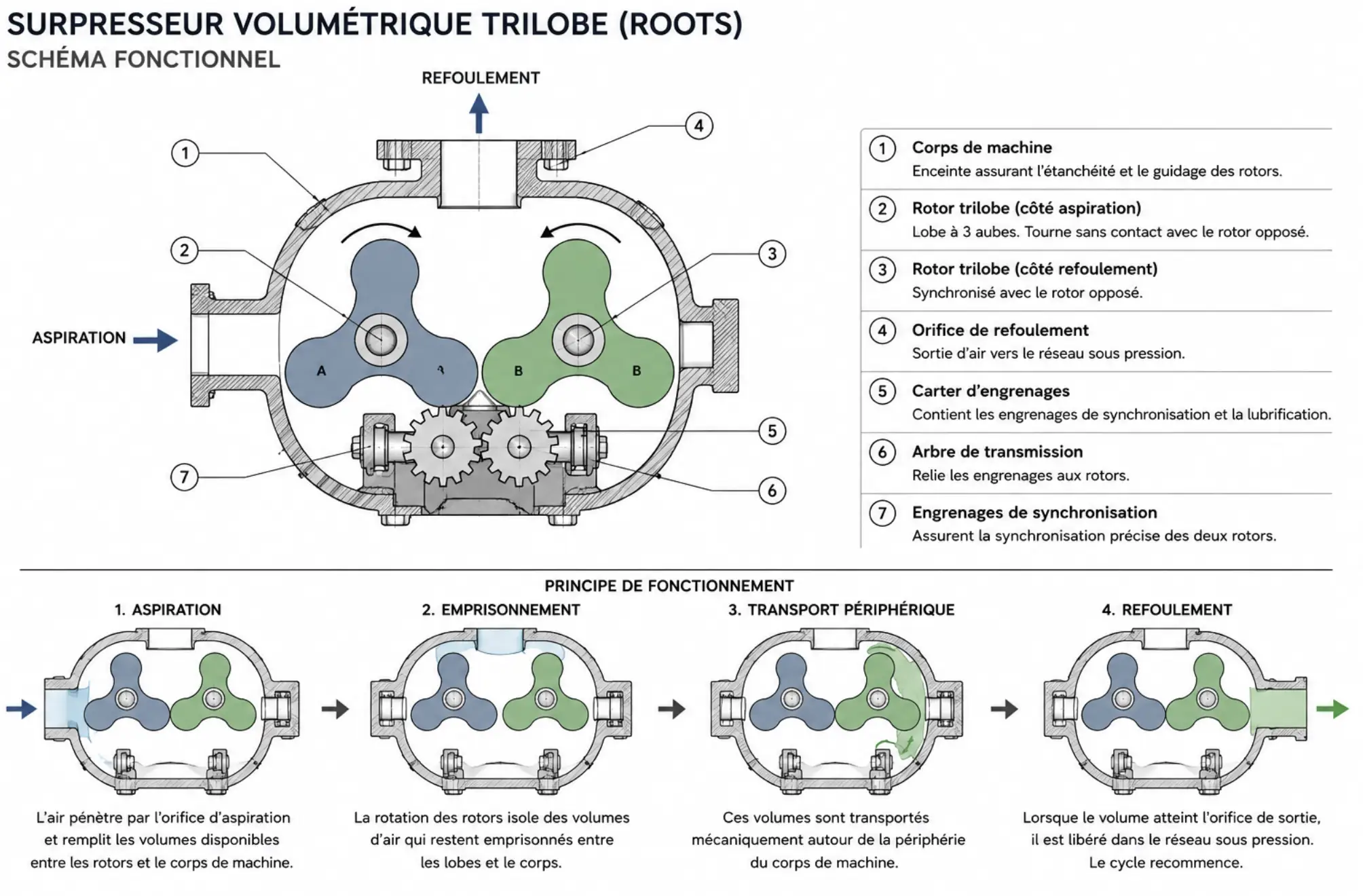
The machine casing, generally made of high-strength cast iron, forms the main structure and ensures the mechanical rigidity of the unit.
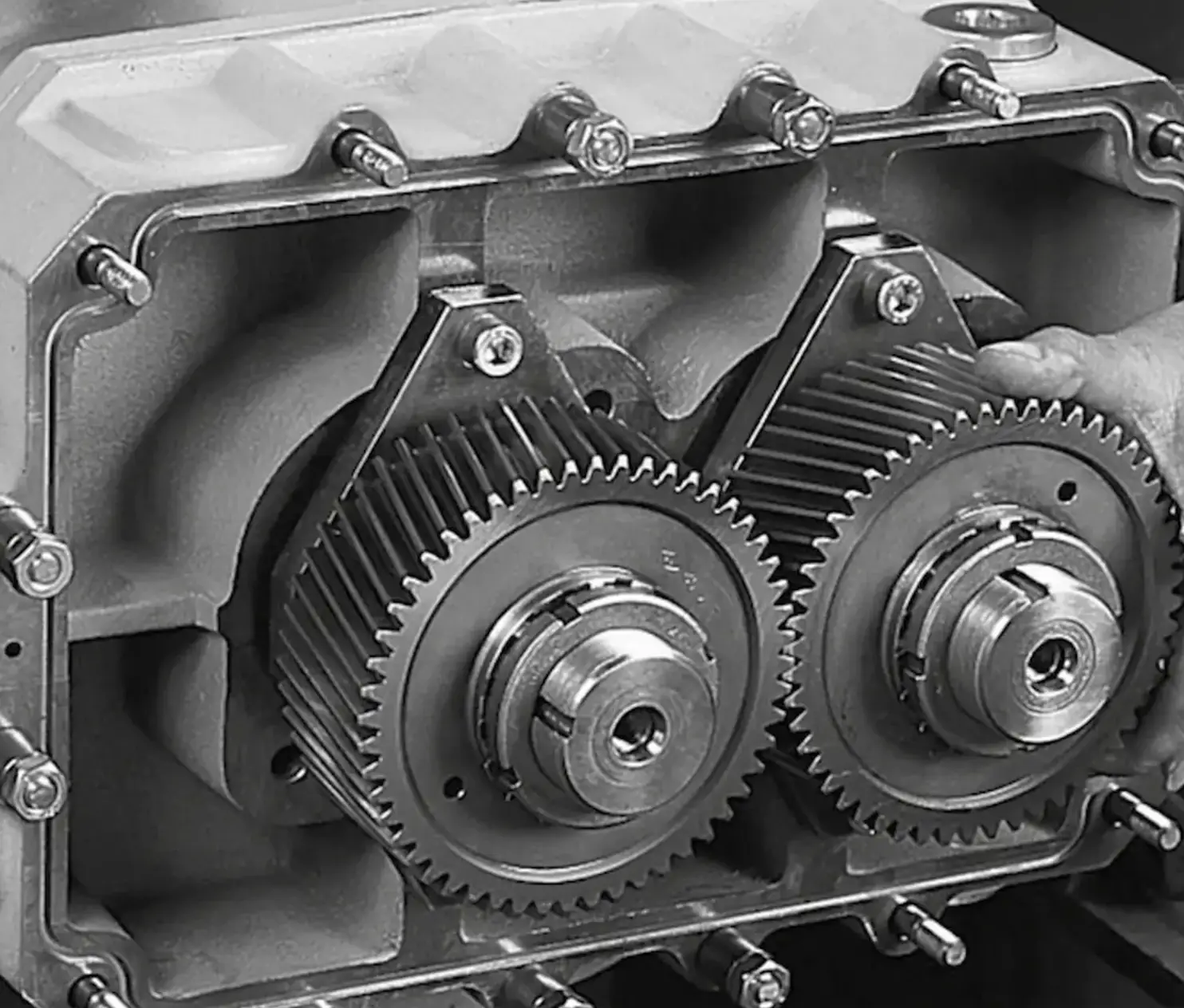
Inside, two tri-lobe rotors rotate, perfectly synchronized by precision gears. These rotors never touch, which significantly limits mechanical wear.
The shafts transmit motion between the motor and the rotors.
The gear housing contains the synchronization components and their lubrication system.
Depending on the configuration, the assembly can be supplemented with intake and discharge silencers, temperature and pressure sensors, and an acoustic enclosure to reduce noise levels.
Atlas Copco LUTOS DT blower packages integrate these various components into a ready-to-install solution that simplifies on-site integration.
How does a Roots blower work?
The operation of a Roots blower is based on two tri-lobe rotors rotating in opposite directions inside a precision-machined housing.
Unlike a screw or piston compressor, there is no significant internal compression in the blowing chamber.
The two rotors simply create closed volumes that transport air from the inlet to the outlet.
Intake: Air enters the blower through the inlet port and fills the spaces between the rotors and the machine casing.
Air volume entrapment: The rotation of the lobes isolates a specific quantity of air, which remains trapped between the rotors and the housing.
Peripheral transport: This volume is mechanically moved around the periphery of the pump body to the discharge side.
Discharge: When the volume reaches the outlet, it encounters the backpressure of the industrial system and is released into the process. The cycle then begins again immediately. This simple kinematics explains the robustness of Roots blowers and their ability to operate continuously for long periods with very little wear.
How is overpressure measured?
To fully understand how an industrial blower works, it is essential to distinguish the concept of overpressure from that used in vacuum applications.
While a vacuum pump operates below atmospheric pressure, a blower works at positive pressure. Its purpose is to slightly increase air pressure to deliver it to an industrial process.
The most commonly used units are the relative millibar mbar(g), the relative bar bar(g), and the kilopascal kPa(g).
Flow rate is generally expressed in m³/h, Nm³/h, or m³/min, depending on the manufacturer.
In most industrial applications, Roots-type blower units operate at pressures of up to approximately 1,000 mbar(g) while delivering flow rates that can exceed several thousand cubic meters per hour.
It is essential to remember that a blower should never be chosen based solely on its maximum pressure. The available flow rate, system pressure drops, and process characteristics are equally decisive.
What is the difference between an industrial blower and an industrial compressor?
While both industrial blowers and compressors handle air, they serve different purposes.
A blower is designed to move a large volume of air at low pressure. It is particularly well-suited for continuous blowing, aeration, pneumatic conveying, or process air supply applications.
A compressor, on the other hand, is designed to produce compressed air at a much higher pressure. It is used to power pneumatic tools, compressed air systems, cylinders, or equipment requiring several bars of pressure.
The main difference therefore lies in the flow/pressure ratio. The blower prioritizes volumetric flow, while the compressor prioritizes pressure.
Comparison between a Roots blower and an industrial compressor:
Critère
Surpresseur Roots
Compresseur industriel
Fonction principale
Déplacer un grand volume d'air
Comprimer l'air à haute pression
Niveau de pression
Jusqu'à environ 1 000 mbar(g)
Plusieurs bars
Débit
Très élevé
Moyen à élevé
Applications courantes
Aération de bassins, transport pneumatique, air process, soufflage industriel
Réseaux d'air comprimé, outils pneumatiques, vérins, process industriels
Fonctionnement continu
Très adapté
Adapté selon la technologie utilisée
Rendement en basse pression
Très bon
Généralement moins adapté
Consommation énergétique
Optimisée pour les applications basse pression
Optimisée pour les applications haute pression
Technologie courante
Pistons rotatifs type Roots (blower)
Vis, piston ou centrifuge
Maintenance
Réduite grâce à l'absence de contact entre les rotors
Industrie générale, ateliers, lignes de production, instrumentation
The advantages of Roots technology
Roots technology is currently one of the most widely used solutions in the field of industrial blowing and low-pressure boosting.
Its simple operating principle, based on two synchronized rotors rotating without contact, provides excellent mechanical robustness and high reliability for continuous operation.
Roots blowers are particularly valued for applications requiring a high air flow rate at moderate pressure.
Compared to other blowing technologies, they offer an excellent balance between performance, maintenance, and operating costs.
Key advantages
Constant flow rate over a wide operating range.
24/7 continuous operation.
No contact between rotors, minimizing mechanical wear.
Simple preventive maintenance.
Long component service life.
High efficiency for low-pressure applications.
Suitable for demanding industrial environments.
Available in numerous sizes and configurations.
Compatible with aeration, pneumatic conveying, and process air applications.
The most widely used industrial blower technologies
Not all industrial applications require the same blower technology.
The choice depends primarily on the required airflow, differential pressure, desired energy efficiency, maintenance constraints, and the specific industrial process.
The main technologies used in the industry are:
Roots-type rotary piston blowers.
Roots blowers are currently the most common technology for industrial blowing, biological basin aeration, pneumatic conveying, and process air applications.
They are characterized by high volumetric flow, excellent mechanical reliability, and continuous operation.
Screw blowers generally offer better energy efficiency across certain operating ranges and help reduce airflow pulsations.
Centrifugal blowers are used for very high airflow rates in certain specific industrial installations.
Complete blower packages ready for installation, integrate the blower, motor, transmission, silencers, safety components, and control instruments into a single, manufacturer-optimized assembly.
Key industrial applications for blowers.
Thanks to their mechanical simplicity and excellent reliability, industrial blowers are used in a wide range of business sectors.
They provide a continuous supply of process air while minimizing maintenance costs and energy consumption.
Wastewater treatment plants and biological basin aeration.
Water treatment plants use blowers to inject air into biological basins. This oxygen supply allows bacteria to break down organic matter in the wastewater. Continuous operation is a critical factor here to ensure treatment quality.
Pneumatic conveying
Pneumatic conveying involves moving powders, granules, or bulk products using an airflow. Blowers power these networks by providing a stable flow rate, enabling transport over tens or even hundreds of meters.
This technology is widely used in plastics processing, cement plants, the food industry, and mineral industries;
At GEFI, sizing these installations takes into account flow rate, pressure drop, and available pressure simultaneously to optimize the network's overall performance.
Unsure about sizing your blower?
Every process has its own unique constraints. GEFI helps you choose the right blower package, without unnecessary oversizing.
The most common mistakes when choosing an industrial blower
Choosing based solely on pressure.
Underestimating system pressure drops.
Neglecting 24/7 continuous operation.
Overlooking acoustic constraints.
Unnecessarily oversizing the installation.
The industrial blower is now an essential technology for many applications requiring continuous, reliable, and cost-effective air supply.
Whether for basin aeration, pneumatic conveying, material handling, or process air supply, choosing the right equipment relies on a precise analysis of operating constraints and production goals.
With our expertise in industrial vacuum and pressure systems, GEFI supports manufacturers in the selection, sizing, installation, and maintenance of high-performance blower packages, particularly those featuring Atlas Copco LUTOS DT solutions.
GEFI expertise for your industrial pressure project.
At GEFI, our approach goes beyond simply supplying equipment. Our goal is to analyze your entire industrial process to propose a solution that aligns with your specific requirements for flow, pressure, energy consumption, maintenance, and operation.
This process often helps identify optimization opportunities that go well beyond a simple machine replacement.
Choosing a blower is about more than just picking a machine from a catalog.
Every industrial process has its own unique constraints regarding flow, pressure, pressure drops, operating environment, maintenance, and energy efficiency.
At GEFI, our approach is primarily based on analyzing the process and the client's actual needs.
We support manufacturers with:
Technical assessment of existing installations
Sizing of blower packages
Selecting the most suitable technology
Integration into new or existing networks
Improving energy performance
Equipment maintenance and monitoring.
Our expertise covers solutions from internationally recognized manufacturers in the industrial blowing and vacuum sector, including Atlas Copco, Pedro Gil, DVP Vacuum Technology, Pneumofore, and MD-Kinney.
This diversity of technologies allows us to offer a solution consistent with the specific constraints of each project, without being limited to a single product range.
Our goal remains the same: to provide a reliable, durable, and cost-effective installation that is perfectly suited to the demands of the field.
Components to monitor:
During preventive maintenance, special attention should be paid to rotors, timing gears, bearings, seals, any belts, intake and discharge silencers, and the system's safety devices.
Your questions about industrial blowers
What is the difference between a blower and a compressor?
A compressor generally produces much higher pressures. A blower is designed to provide a high flow rate at relatively low pressure, making it particularly suitable for industrial blowing applications.
How does a Roots blower work?
Two synchronized rotors rotate in opposite directions inside a housing, mechanically transporting volumes of air from the intake to the discharge without significant internal compression.
Can a blower run continuously?
Yes. Industrial blowers are specifically designed to operate 24/7 when properly sized and maintained.
What maintenance is required?
Regular preventive maintenance, including checking filters, lubrication, any belts, bearings, and safety components, helps ensure the longevity of the system.
How do I choose the right flow rate?
The flow rate must be determined based on the industrial process, system pressure drops, and production goals.
A technical study is often essential to avoid under-sizing or over-sizing.
Do blowers consume a lot of energy?
Like any industrial equipment, their consumption depends primarily on sizing and operating conditions.
An optimized installation generally allows for a significant reduction in energy costs.
Need technical support?
The GEFI team is at your disposal to study your project and offer a pressure solution perfectly suited to your industrial application. Contact us for a personalized study or to request a quote.
Choosing an industrial blower cannot be limited to comparing a few technical specifications. Every process has its own operational constraints and requires a comprehensive analysis of the installation.
The required airflow is the primary sizing criterion.
The flow rate represents the volume of air the blower must provide. It is very often the primary selection criterion. Insufficient flow can lead to a drop in process performance or a significant decrease in productivity.
Operating pressure: matching the blower to production requirements
Available pressure must account for network pressure drops as well as specific application needs. Unnecessary oversizing generally increases energy consumption without providing any real benefit.
Operational adjustments to match the blower to production requirements
Some facilities operate for a few hours a day, while others run 24/7. The choice of bearings, motorization, and cooling systems must take these constraints into account.
Acoustic constraints for reducing noise levels when necessary
In certain industrial environments, noise level is a major criterion. Units equipped with an acoustic enclosure can significantly reduce noise emissions while maintaining blowing performance.
Energy goals: controlling operating costs
Energy costs represent a significant portion of a blower's total cost of ownership. A proper sizing study can often provide a lasting reduction in the facility's electricity consumption.
ConseilGEFI
Le meilleur surpresseur n'est pas nécessairement le plus puissant.
C'est avant tout celui dont les performances correspondent précisément aux besoins réels du procédé industriel, avec un compromis optimal entre débit, pression, rendement énergétique et coût d'exploitation.
GEFI propose notamment les groupes de surpression Atlas Copco LUTOS DT, disponibles dans de nombreuses configurations de débit et de puissance.
Ces ensembles prêts à installer intègrent le blower, la motorisation, les organes de sécurité et les accessoires nécessaires à une mise en service rapide sur site.
Why optimize your blower system?
In many factories, blower units operate for years without any real performance analysis being conducted.
However, an improperly sized or aging system can lead to a significant increase in operating costs and a gradual decline in process performance.
The main causes of efficiency loss are:
Flow rates that do not match actual needs
Oversized operating pressure
Significant pressure drops in the network
Clogged filters
Optimizing the installation can lead to:
Optimisation possible
Bénéfice attendu
Réduction de la consommation électrique
Baisse des coûts énergétiques
Amélioration de la stabilité du débit
Meilleure régularité du procédé
Limitation des arrêts de production
Disponibilité accrue de l'installation
Augmentation de la durée de vie des équipements
Moins d'usure et de remplacements
Diminution des coûts de maintenance
Entretien global mieux maîtrisé
At GEFI, we regularly conduct technical studies to identify the most relevant areas for improvement before any investment is made.
Atlas Copco LUTOS DT blower packages: a ready-to-install solution.
Atlas Copco LUTOS DT blower packages are designed to meet the needs of industrial users looking for a reliable, high-performance solution that can be quickly integrated into their facilities.
Each unit includes a rotary lobe blower, a matched motor, an optimized drive system, safety components, and all the accessories required for quick commissioning.
The range covers a wide variety of needs, with flow rates of up to 8,000 m³/h and pressures up to 1,000 mbar(g), depending on the model.
Acoustic enclosure versions are also available to meet noise reduction requirements at certain industrial sites.