


%20(2).webp)
What is a liquid ring vacuum pump?
A liquid ring vacuum pump is a rotary positive displacement pump designed to draw in air, gases, or vapors and create a vacuum in an industrial process or installation.
Its operating principle relies on a seal liquid, typically water, which is driven by centrifugal force to form a liquid ring inside the pump casing. This liquid ring provides sealing and cooling while enabling the gas to be drawn in and compressed.
One of the key features of liquid ring vacuum pump technology is the absence of metal-to-metal contact within the compression chamber. This robust design makes the pump particularly well suited to demanding operating conditions, including applications involving moisture, condensable vapors, liquid carryover, or chemically aggressive gases, provided that suitable materials and seal liquids are selected.
Thanks to this design, liquid ring vacuum pumps are widely used in industrial processes requiring high reliability, durability, and excellent tolerance of wet or condensable gas streams.
Operating principle of a liquid ring vacuum pump
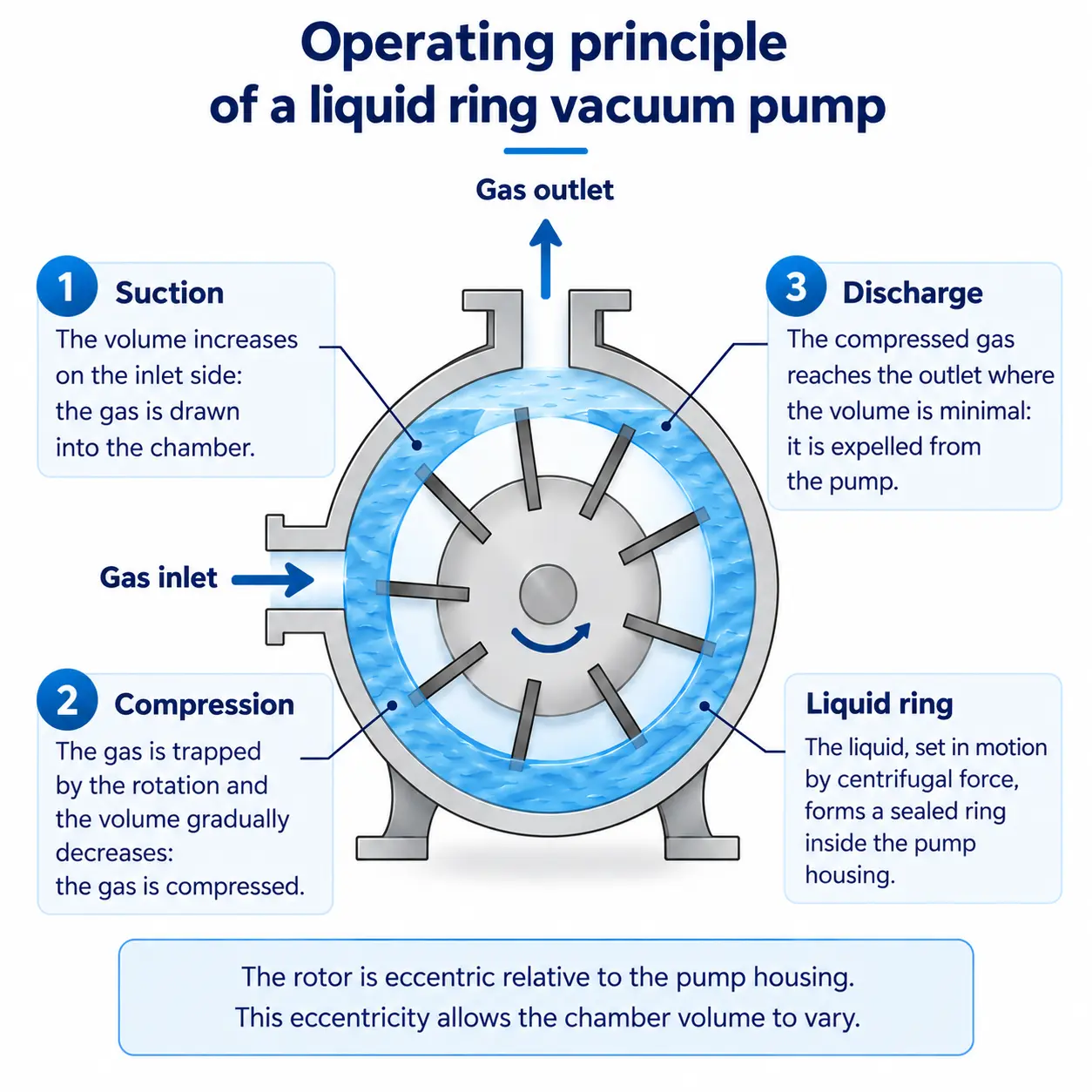
The operation of a liquid ring vacuum pump is based on the rotation of an impeller mounted eccentrically inside a pump casing partially filled with seal liquid. Under the effect of centrifugal force, this liquid forms a ring against the inner wall of the casing. The space between the impeller and the liquid ring creates chambers of varying volume, enabling the intake, compression, and discharge of gases.
Typically consisting of water, the seal liquid is driven by the rotating impeller. Centrifugal force distributes it around the inner wall of the pump casing, while the eccentric position of the impeller creates chambers whose volume changes continuously throughout the rotation cycle.
As the volume of a chamber increases, gas is drawn into the pump through the inlet port. As the impeller continues to rotate, the gas becomes trapped between the impeller blades and the liquid ring and is carried toward the discharge port. The gradual reduction in chamber volume compresses the gas until it is discharged from the pump.
The seal liquid simultaneously performs several essential functions:
- It provides a seal between the individual compression chambers
- It absorbs and dissipates part of the heat generated during gas compression
- It helps prevent direct metal-to-metal contact within the compression chamber, contributing to reliable operation and reduced wear.
This operating principle explains why liquid ring vacuum pumps are particularly well suited to handling wet gases, condensable vapors, and gas streams containing small amounts of entrained liquid.
The four stages of the operating cycle
1. Suction: gas enters the pump
As the impeller rotates, the volume of the pumping chambers gradually increases. This expansion creates a vacuum that draws air, gas, or vapor into the pump through the inlet port. The gas then fills the spaces between the impeller blades and the liquid ring.
2. Gas transfer: gas is trapped in the pumping chamber
As the impeller continues to rotate, the incoming gas becomes trapped between two successive impeller blades and the liquid ring. The liquid acts as a moving boundary, carrying the gas toward the discharge side of the pump. This design enables gas transfer without direct metal-to-metal contact between the rotating and stationary components within the compression chamber.
3. Compression: chamber volume gradually decreases
As the rotation continues, the volume of the pumping chambers gradually decreases. The trapped gas is progressively compressed until it reaches the pressure required for discharge. During this phase, the seal liquid also absorbs part of the heat generated by compression.
4. Discharge: compressed gas is expelled
When the pumping chambers reach the discharge port, the compressed gas is expelled from the pump together with a portion of the seal liquid. Depending on the system design, the liquid can then be separated from the gas, cooled, and recirculated back into the pump, or replaced with fresh seal liquid.
The main components of a liquid ring vacuum pump
Although liquid ring vacuum pumps are available in many configurations, their design is based on a limited number of key components, each playing an essential role in the pump's operation.
Understanding their function helps explain how a liquid ring vacuum pump works and identify the main components that should be monitored during maintenance.
The pump casing creates the conditions for the liquid ring to form
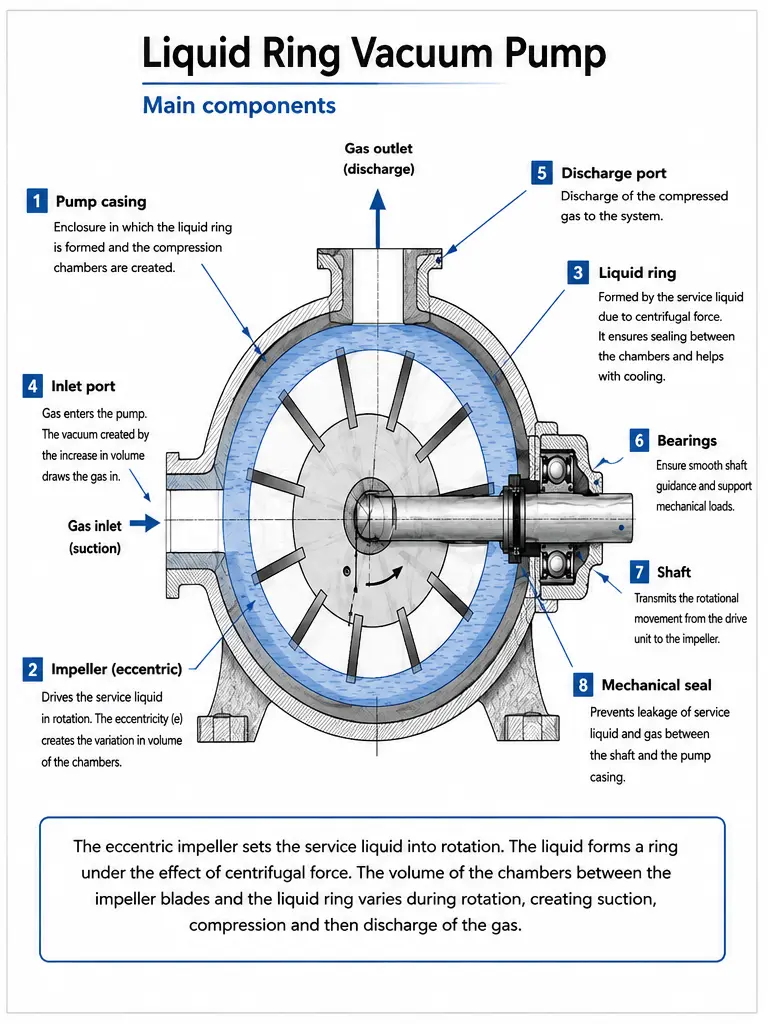
The pump casing forms the chamber in which the pumping cycle takes place. Its geometry allows the seal liquid to form a stable liquid ring under the effect of the rotating impeller. This design, combined with the eccentric position of the impeller, creates the variable-volume pumping chambers required for suction, compression, and discharge.
Depending on the application, the pump casing and internal components can be manufactured from cast iron, stainless steel, or other materials selected to withstand corrosive gases, liquids, or demanding chemical environments.
The impeller drives the seal liquid in rotation
The impeller is the main rotating component of the pump. As it rotates, it sets the seal liquid in motion and generates the centrifugal force required to form the liquid ring. Its eccentric position within the pump casing causes the volume of the pumping chambers to increase and decrease during each revolution.
The seal liquid provides sealing and cooling
Usually water, the seal liquid performs several essential functions. It provides sealing between the pumping chambers, absorbs part of the heat generated during gas compression, and plays a direct role in the compression process. Depending on the application, water can be replaced by another liquid compatible with the process gas and operating conditions.
The liquid performs several functions simultaneously:
- Sealing between the pumping chambers
- Absorption and removal of heat generated during compression
- Formation of the moving boundary required for gas compression
- Improved tolerance of moisture, condensates, and certain process contaminants.
The inlet and discharge ports guide the gases
The inlet and discharge ports control the flow of gas into and out of the pumping chambers throughout the operating cycle. Their position and geometry are designed to ensure efficient gas flow while minimizing pressure losses.
Bearings and shaft seals maintain pump reliability
Bearings support and guide the rotating shaft, while shaft sealing systems help prevent leakage between the pump and the surrounding environment. Their condition is important for maintaining pump reliability, service life, and overall performance.
Depending on the pump design and application, shaft sealing may be provided by mechanical seals, packing arrangements, or other sealing technologies. Mechanical seals help prevent leakage of seal liquid or process gas along the rotating shaft.
Their condition should be checked regularly as part of a preventive maintenance program.
Key takeaway:
The vacuum level achievable with a liquid ring vacuum pump depends significantly on the temperature and vapor pressure of the seal liquid. As the seal liquid temperature increases, its vapor pressure also increases, which can limit the maximum vacuum the pump can achieve. Depending on process requirements, the vacuum system may therefore incorporate a cooling system or a partial or full seal-liquid recirculation circuit to maintain stable performance.

.webp)