


%20(2).webp)
What is a liquid ring vacuum pump?
A liquid ring vacuum pump is a rotary positive displacement pump designed to draw in air, gases, or vapors to create a vacuum in an industrial installation.
Its principle relies on a service fluid driven by centrifugal force inside the machine. It simultaneously ensures sealing, cooling, and pressure increase of the gases.
Unlike rotary vane or claw vacuum pumps, this technology involves no contact between moving parts and the gas being pumped. This unique feature allows it to operate in particularly demanding conditions, especially in the presence of moisture, condensates, or certain chemical compounds.
Thanks to this design, it is widely used in processes requiring high durability and excellent resistance to wet gases.
Operating principle of a liquid ring vacuum pump
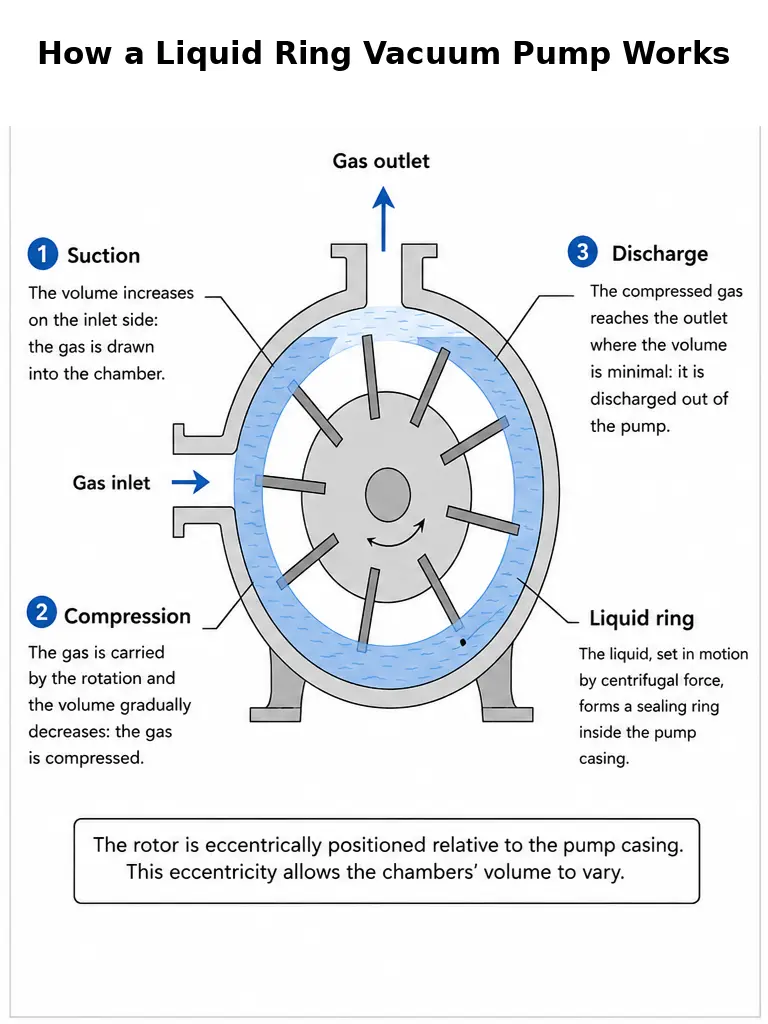
The operation of this pump is based on the rotation of an impeller mounted eccentrically within a pump housing partially filled with service liquid. Under the effect of centrifugal force, this fluid is distributed against the inner wall of the machine. The space remaining between the impeller and this ring creates cells of variable volume, allowing for the suction, compression, and discharge of gases.
Generally consisting of water, the fluid is driven by an eccentric impeller. Centrifugal force distributes it uniformly against the inner wall of the machine. The eccentricity of the impeller creates chambers whose volume varies throughout the cycle.
When the volume of a chamber increases, gas is drawn in through the inlet port. As rotation continues, this gas is trapped between the impeller blades and the liquid ring, then transported toward the discharge zone. The gradual decrease in volume increases the gas pressure until it is expelled.
The service liquid simultaneously plays several essential roles:
- It ensures a seal between the various compression chambers
- It dissipates some of the heat generated during pumping
- It protects mechanical components by limiting direct friction with the pumped gas.
This design explains why these pumps are particularly well-suited for pumping wet gases, condensable mixtures, or gases containing small amounts of liquid.
The four stages of the operating cycle
1. Suction: gas enters the pump
As the impeller rotates, the volume of the cells gradually increases. This expansion creates a vacuum that draws air or gas in through the inlet port. The gas then fills the spaces available between the blades and the ring.
2. Compression: gas is isolated in a pumping chamber
The impeller then carries the drawn-in gas into a closed chamber. The fluid acts as a moving wall, isolating the gas between two successive blades. The gas is thus mechanically transported toward the discharge zone without coming into direct contact with the pump's metal components.
3. Compression: volume gradually decreases
During the cycle, the volume of the cells gradually decreases. The drawn-in gases are compressed until they reach the pressure required for discharge. The fluid also helps cool the gases during this phase.
4. Discharge: compressed gas is expelled
When the cells reach the discharge port, the compressed gases are expelled from the pump. The service liquid remains in the pump casing to immediately begin a new operating cycle.
The main components of a liquid ring vacuum pump
Although they come in many configurations, their architecture is based on a limited number of components, each playing an essential role in the machine's operation.
Understanding their function helps to better grasp the operating principle of this technology and identify the elements to monitor during maintenance operations.
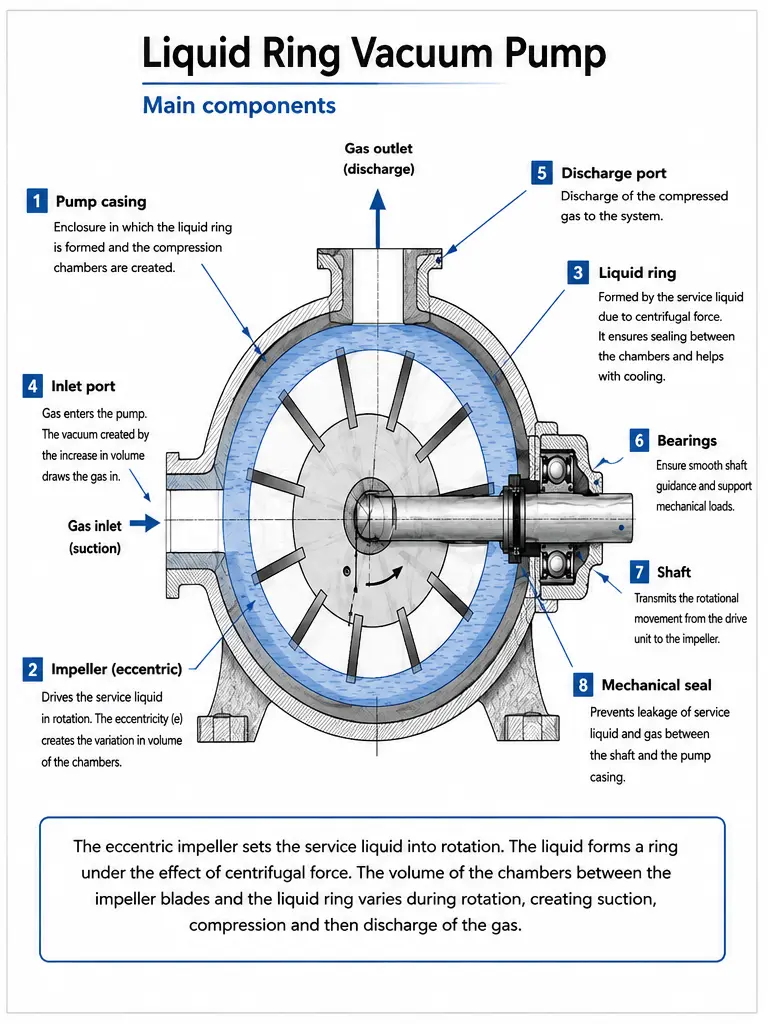
The pump casing creates the conditions for the liquid ring to form
The pump casing forms the housing in which the pumping cycle takes place. Its geometry allows the service liquid to form a stable ring under the effect of the impeller's rotation. This design ensures the creation of variable-volume cells essential for the equipment's operation.
Depending on the application, it can be manufactured from cast iron, stainless steel, or specific materials designed to withstand corrosive fluids or particularly aggressive chemical environments.
The impeller drives the service liquid in rotation
The impeller is the system's driving element. By rotating at high speed, it sets the service liquid in motion and generates the centrifugal force required to form the ring. Its eccentric mounting allows the volume of the pumping cells to vary during each rotation.
The service liquid provides sealing and cooling
Usually water, it performs several essential functions. This fluid provides a seal between the various chambers, limits gas heating, and participates directly in the compression process. Depending on the application, it can be replaced by another fluid compatible with the process requirements.
The liquid performs several functions simultaneously:
- Sealing between pumping chambers
- Pump cooling
- Removal of some of the heat of compression
- Protection against certain types of contamination.
The suction and discharge ports guide the gases
The intake and discharge ports allow for the entry and subsequent evacuation of gases throughout the cycle. Their position is engineered to ensure smooth flow and minimize pressure drops.
Bearings and seals maintain pump reliability
Bearings guide the rotating shaft, while seals ensure a leak-tight connection between stationary and moving parts. Their quality is essential to the reliability, service life, and performance of the installation.
Mechanical seals prevent service liquid or gas leaks and help maintain long-term pump performance.
Their condition should be checked regularly as part of your preventive maintenance routine.
Good to know:
The vacuum level achieved depends largely on the service liquid temperature and the vapor pressure of the fluid used. As the temperature rises, vapor pressure increases, which can limit the maximum achievable vacuum. Depending on specific process requirements, vacuum systems may incorporate a cooling or recirculation circuit to stabilize performance.

.webp)