Industrial Vacuum: physical and technological principles of vacuum pumps
Published on November 2, 2026
Product description
Vacuum technology plays a critical role element of many manufacturing processes. It is used in food packaging, thermoforming, plastics processing, pharmaceuticals, chemistry, electronics, metallurgy, and research laboratories.
Vaccum is often mistakenly perceived as a completely empty space or as the result of a pump simply drawing air out. The reality is quite different. Vacuum is, above all, a physical state governed by the principles of thermodynamics, gas kinetics, and fluid mechanics.
This article explores the fundamental physical principles governing industrial Vacuum: the origin of pressure, gas laws, molecular behavior, and the operating principles of pumps.
Table of contents
Defining industrial Vacuum: absolute pressure and molecular density
It refers to a state in which the pressure is lower than atmospheric pressure. In other words, it is not a space completely devoid of matter, but an environment where the number of molecules present is lower than that observed in the atmosphere.
Even at very low pressure, residual molecules remain: a perfect Vacuum remains a theoretical limit.
The role of a vacuum pump is therefore not to create a vacuum, but to gradually extract the gas molecules present in a chamber in order to reduce its pressure.
How molecules create pressure
Before understanding Vacuum, it is essential to understand the origin of pressure.
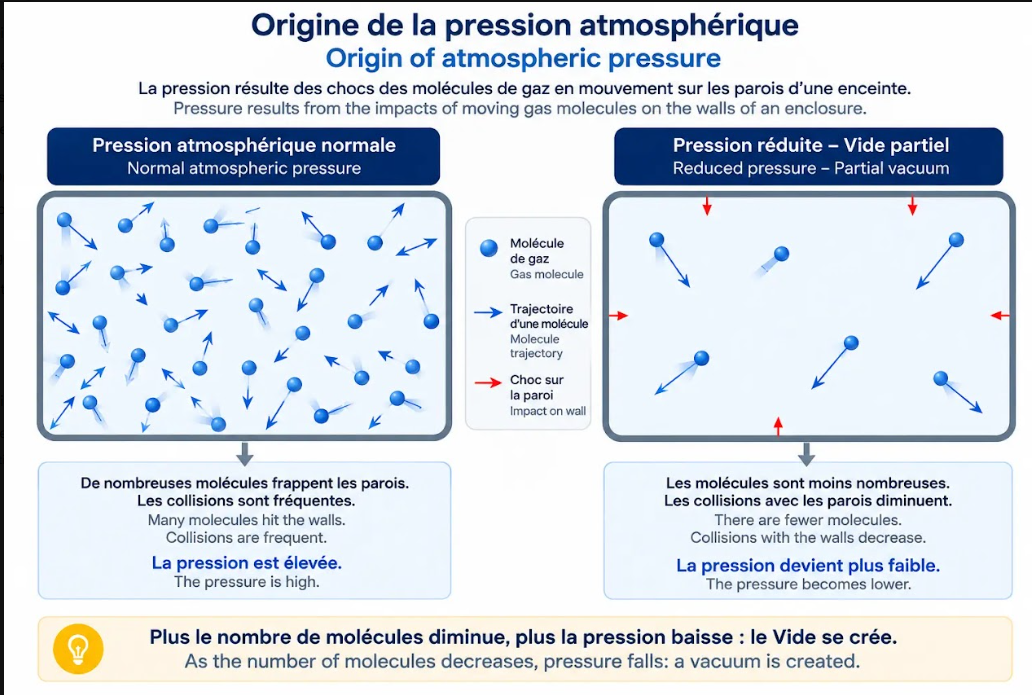
The air around us consists mainly of nitrogen, oxygen, argon, and a few other gases. All these molecules are in constant motion. They move at several hundred meters per second and are continuously colliding with each other as well as with the surfaces they encounter.
At our scale, these movements are invisible. Yet, they are responsible for a fundamental phenomenon: pressure.
Each collision of a molecule with a wall exerts a force. The sum of these impacts produces the pressure measurable in the system.
The more molecules there are, the more collisions increase and the higher the pressure. Extracting them produces the opposite effect: the pressure decreases.
At the molecular scale, each gas particle possesses a kinetic energy linked to its speed and temperature. This energy is responsible for its constant motion and the countless collisions with other molecules and surfaces, which are the source of the pressure observed in a gaseous system.
The physical explanation for pressure difference
Contrary to popular belief, a Vacuum does not "suck" anything.
When a suction cup sticks to a window, it is not the vacuum that pulls the cup. It is the external atmospheric pressure, which is higher than the pressure beneath the cup, that exerts a force and presses it against the surface. Therefore, it is the pressure difference that produces the observed force.
The role of atmospheric pressure in vacuum phenomena
The physical principles governing a Vacuum
The behavior of a gas under Vacuum is described by the kinetic theory of gases, developed in the 19th century by physicists such as Maxwell and Boltzmann.
This theory considers a gas to be composed of a vast number of molecules in constant motion, moving in a completely disordered manner.
Four concepts for understanding how industrial vacuum systems work
How thermal agitation influences gas behavior
The speed of molecules depends on their temperature: the hotter a gas is, the more their agitation increases. This phenomenon directly influences the performance of a Vacuum installation.
Understanding the mean free path of gas molecules
The mean free path represents the average distance a molecule travels between two successive collisions.
Very short at atmospheric pressure, this distance increases as the pressure decreases. This phenomenon directly influences the choice of pumping technologies.
Molecular density: an indicator of Vacuum level
Molecular density corresponds to the number of molecules present in a given volume.
As the pump extracts gases, this density gradually decreases.
It is this reduction in molecular density, rather than the creation of an "empty space," that physically characterizes a vacuum.
The main gas laws applied to Vacuum technology
Several fundamental laws of physics explain the variations in pressure, volume, temperature, and the movement of gases. They are essential for the sizing and optimization of installations.
Boyle's Law
Formulated in the 17th century, Boyle's Law states that at a constant temperature, the pressure of a gas varies inversely with its volume.
In other words, when volume decreases, pressure increases. Conversely, when volume increases, pressure decreases.
This principle is the basis for the operation of many positive displacement vacuum pump technologies.
In a rotary vane pump, the volume of the pumping chambers varies as the rotor turns. This variation allows gas to be drawn in and then discharged to the outside.
Understanding the ideal gas law to explain gas behavior under Vacuum
The ideal gas law relates four fundamental parameters:
Pressure
Volume
Temperature
Amount of substance
This relationship explains why a change in temperature directly influences the vacuum level achieved.
When a gas heats up, its molecules become more agitated and collide more frequently with the walls. Conversely, cooling promotes a decrease in pressure.
This relationship is particularly important during vacuum drying, degassing, or freeze-drying processes.
How molecular diffusion influences vacuum levels
Gas molecules naturally seek to distribute themselves homogeneously throughout a space.
This phenomenon, known as molecular diffusion, explains why a leak, even an extremely small one, will always eventually degrade the vacuum level of an installation. The higher the Vacuum, the more significant this diffusion becomes.
Key takeaways on gas laws
Physical laws help explain why two installations equipped with the same pump can achieve very different performance levels depending on their temperature, volume, airtightness, or the nature of the gases being pumped.
Looking to optimize the performance of your industrial vacuum system?
GEFI experts are here to help you select and size your vacuum pumps, taking into account the specific technical requirements of your process.
Not all applications require the same level of vacuum.
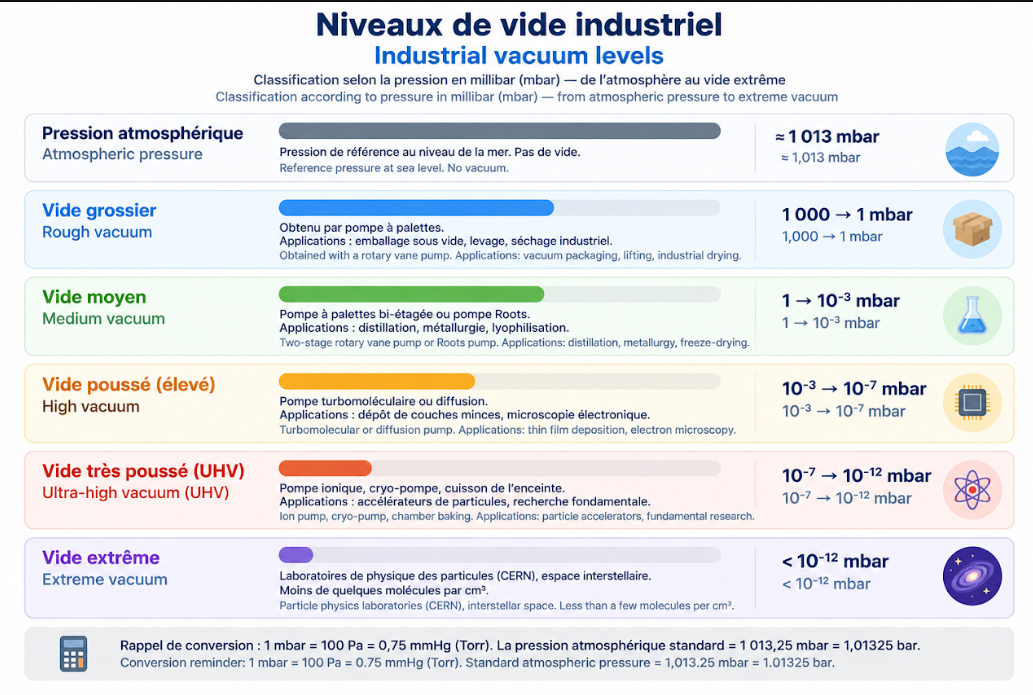
Specialists distinguish between several ranges, each corresponding to specific physical phenomena and technologies.
Comparative table of vacuum levels
Values may vary slightly depending on standards and fields of application.
Each vacuum range corresponds to a different behavior of gas molecules. As pressure decreases, molecular phenomena take precedence over those related to conventional flow.
How does a pump create a Vacuum?
Once you understand the physical phenomena that govern Vacuum, it becomes easier to grasp the role of a vacuum pump.
Contrary to popular belief, a vacuum pump does not "produce" a Vacuum. Instead, it gradually extracts the gas molecules present in a closed chamber. As their number decreases, molecular density drops and pressure falls.
The principle is the same regardless of the technology used. However, the methods used to transport the molecules differ from one pump to another.
Each technology has an optimal operating range, a specific vacuum level, and preferred application areas. Some vacuum pumps operate without oil, such as dry screw vacuum pumps. Others use lubricating oil or a liquid ring to ensure gas compression, cooling, and sealing.
To learn more about how different technologies work, check out our guide: How does an industrial vacuum pump work? ( = link). Each type of vacuum pump is suited to a specific vacuum system. The choice depends primarily on the required vacuum level, pumping speed, the nature of the gases, and maintenance constraints.
The main types of industrial Vacuum pumps
Vacuum technology relies on several types of vacuum pumps, each tailored to a specific vacuum level, pumping speed, and application. Choosing a vacuum system depends on factors such as the nature of the gases being extracted, the potential presence of water vapor, maintenance requirements, and expected performance.
Oil-lubricated rotary vane vacuum pumps remain widely used for rough vacuum due to their robustness and excellent efficiency. Dry rotary vane vacuum pumps, which operate without oil in the compression chamber, are preferred when process cleanliness is essential.
Screw Vacuum pumps, or dry screw pumps, provide compression without contact between the rotors. They are suitable for processes requiring low maintenance and high reliability. Liquid ring pumps use a liquid ring to achieve compression and are particularly well-suited for wet or vapor-laden gases.
To reach higher Vacuum levels, installations can also incorporate two-rotor Roots pumps, used as boosters to supplement a primary pump. Depending on the application, some vacuum systems may also utilize side-channel blowers or other specialized technologies.
Regardless of the technology chosen, selecting a vacuum pump should always be the result of a comprehensive analysis of the process, the required vacuum level, pumping speed, temperature, gases being extracted, and operational constraints.
How do you measure pressure in a Vacuum system?
Vacuum measurement is essential for monitoring system performance and ensuring the stability of industrial processes.
Unlike standard pressure, vacuum can be measured using various physical principles. Each technology is adapted to a specific pressure range.
Mechanical Vacuum gauges for measuring low Vacuum levels
These measure the deformation of a sensitive element directly under the effect of pressure. Robust and easy to use, they are primarily used for low vacuum levels.
Pirani gauges for measuring rough and medium Vacuum
Pirani sensors utilize a particularly interesting physical phenomenon: the thermal conductivity of gases.
An electrically heated filament loses heat to the surrounding gas. As the number of molecules decreases, the gas removes less heat, causing the filament temperature to rise. The electrical resistance then varies according to the vacuum level.
Penning gauges for measuring high Vacuum levels
Penning gauges use the ionization of gas molecules under the influence of an electric and magnetic field. The current produced is directly related to the number of molecules present in the chamber.
They allow for the measurement of much higher vacuum levels.
Ion gauges for monitoring high Vacuum
For high vacuum applications, ion gauges offer exceptional precision.
They are used in laboratories, particle accelerators, scientific research, and certain advanced industries.
Industrial Vacuum applications and their physical requirements
Food industry: vacuum is used for food packaging, drying, product concentration, pneumatic conveying, and freeze-drying.
Plastics industry: thermoforming relies directly on the pressure difference between the atmosphere and a vacuum-sealed mold.
Pharmaceutical industry: manufacturing processes use vacuum for drying, degassing, distillation, and the freeze-drying of sensitive products.
Chemistry: vacuum allows for the lowering of the boiling point of many compounds, thereby facilitating distillation, evaporation, or solvent recovery operations.
Electronics: the manufacturing of electronic components requires high vacuum levels to prevent any contamination during thin-film deposition.
CONSEIL
GEFI
Chaque procédé industriel présente des exigences spécifiques :
le choix d'une technologie de Vide doit avant tout répondre
aux contraintes réelles de l'installation.
Le niveau de Vide ne suffit pas à déterminer la pompe adaptée :
le débit, la nature des gaz, la température et les conditions
d'exploitation sont également déterminants.
Un dimensionnement maîtrisé fait la différence :
une installation bien conçue permet d'optimiser les performances,
la consommation énergétique et la fiabilité des équipements.
Vacuum physics at the heart of performance
Understanding the physical principles of vacuum allows for better design, operation, and maintenance of industrial installations.
Knowledge of molecular phenomena, gas laws, and the different vacuum levels facilitates, in particular:
Choosing the most suitable technology
Sizing a vacuum pump
Optimizing pump-down time
Reducing energy consumption
Leak detection
Improving process reliability
This approach is precisely what guides the GEFI teams in their technical recommendations.
Rather than systematically proposing a specific technology, we analyze process constraints to select the solution that offers the best balance between performance, reliability, maintenance, and total cost of ownership.
Have a project?
The GEFI team will assist you in choosing the technology best suited to your application.
Understanding the physics of Vacuum to design processes
The choice of technology depends on the required Vacuum level, pumping speed, gas composition, process temperature, and operational constraints. A technical study helps identify the most suitable solution for each application.
Vacuum is more than just a reduction in pressure. It is the result of a set of physical phenomena involving gas molecules, absolute pressure, temperature, energy transfer, and the fundamental laws of thermodynamics.
Understanding these mechanisms—molecular density, collisions, mean free path, gas diffusion, conductance, and the ideal gas laws—allows for better system sizing, accurate performance interpretation, and long-term process optimization.
At GEFI, every technical recommendation is based first and foremost on an analysis of the physical phenomena specific to the application. This approach allows us to select the most relevant technology, improve energy performance, and ensure the long-term reliability of installations. Our teams also provide vacuum system maintenance, pump replacement, and optimization of existing equipment.
Why physics guides the choice of Vacuum technology
The choice of technology never depends on a single criterion. It is the result of a balance between gas characteristics, process requirements, expected performance, energy consumption, and maintenance constraints.
With its expertise in vacuum technologies, GEFI supports industrial clients at every stage of their project:
Process requirements analysis
System sizing
Selection of vacuum technologies
Preventive and corrective maintenance
Supply of spare parts
Energy optimization for existing installations
Our independence from manufacturers allows us to recommend the most relevant solution for every application.
GEFI distributes and provides support for numerous technologies developed by recognized manufacturers such as PEDRO GIL, PNEUMOFORE, MD-Kinney, DVP Vacuum Technology, Leybold, PVR, Atlas Copco, Speck, FPZ, Finder, Edwards, depending on specific needs.
Frequently asked questions about vacuum and its physical principles
Does a perfect Vacuum really exist?
No. A perfect Vacuum corresponds to a total absence of matter and is a theoretical limit. Even the most high-performance systems always contain some residual molecules.
What is an industrial Vacuum system?
A Vacuum system generally combines one or more vacuum pumps, piping, sensors, filters, and control components to achieve the desired vacuum level.
Because a pump does not create a vacuum; it gradually extracts the gas molecules present in a closed chamber, which leads to a decrease in pressure.
Why does temperature influence the Vacuum level?
Temperature changes the agitation of molecules and therefore their behavior. A hotter gas exerts more collisions on the walls, which directly influences the pressure.
Why does humidity complicate the Vacuum process?
Water adsorbed on surfaces evaporates as the pressure decreases. This additional vapor must be pumped out, which increases the time required to reach the desired vacuum level.
To supplement this article, discover some technical data sheets that provide further insight into industrial vacuum equipment and technologies.
An engineer who graduated from Université Paris XI-Saclay and holds a Master's degree in innovation and industrial marketing from Université Paris IX-Dauphine, Ronan Guyader has notably led international subsidiaries of the Air Liquide group.
Since 2021, he has headed GEFI, a solutions integrator specializing in vacuum, overpressure, gas compression and composite covers.